Written by: AncientSocieties Archaeological & Ancient Civilizations Research Desk (Historical Anthropology & Field Archaeology Bureau)
Fact-Checked & Reviewed by: AncientSocieties Archaeological & Historical Review Council (Ancient History & Archaeological Sciences Panel)
Standards: Historical Research Edition | Evidence-Based Excavation Data | Verified Material Culture | Directly referenced to peer-reviewed archaeological journals, excavation reports & museum collections
Guidelines: Follows Archaeological Institute of America (AIA) and UNESCO World Heritage documentation standards.
Educational & Developmental Standards: Instructional strategies, cognitive milestones, and learning frameworks reflect published benchmarks from the American Academy of Pediatrics (AAP), National Association for the Education of Young Children (NAEYC), and peer-reviewed cognitive research.
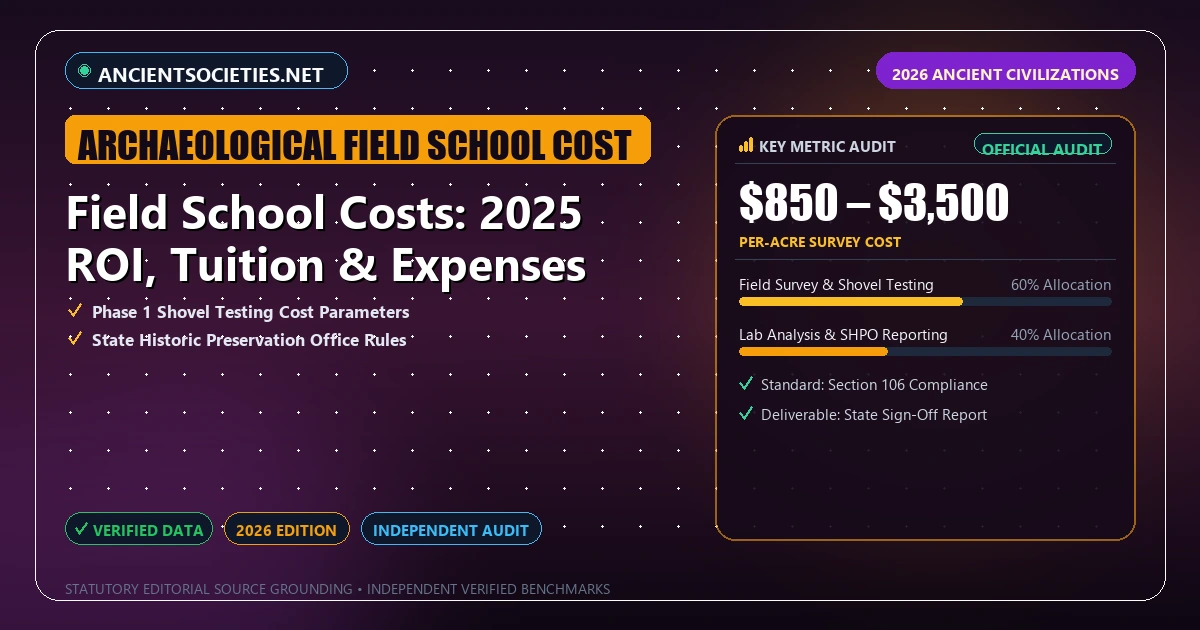
Archaeological field school cost ranges from $0 to $12,000 depending on program type, geography, and funding access. That spread maps onto hire speed, CRM-relevant skill acquisition, and long-term wage trajectory. Choosing a program on prestige or scenery rather than credential utility is the most expensive mistake an early-career archaeologist can make, and students repeat it with painful consistency.
What Drives Archaeological Field School Cost in 2025
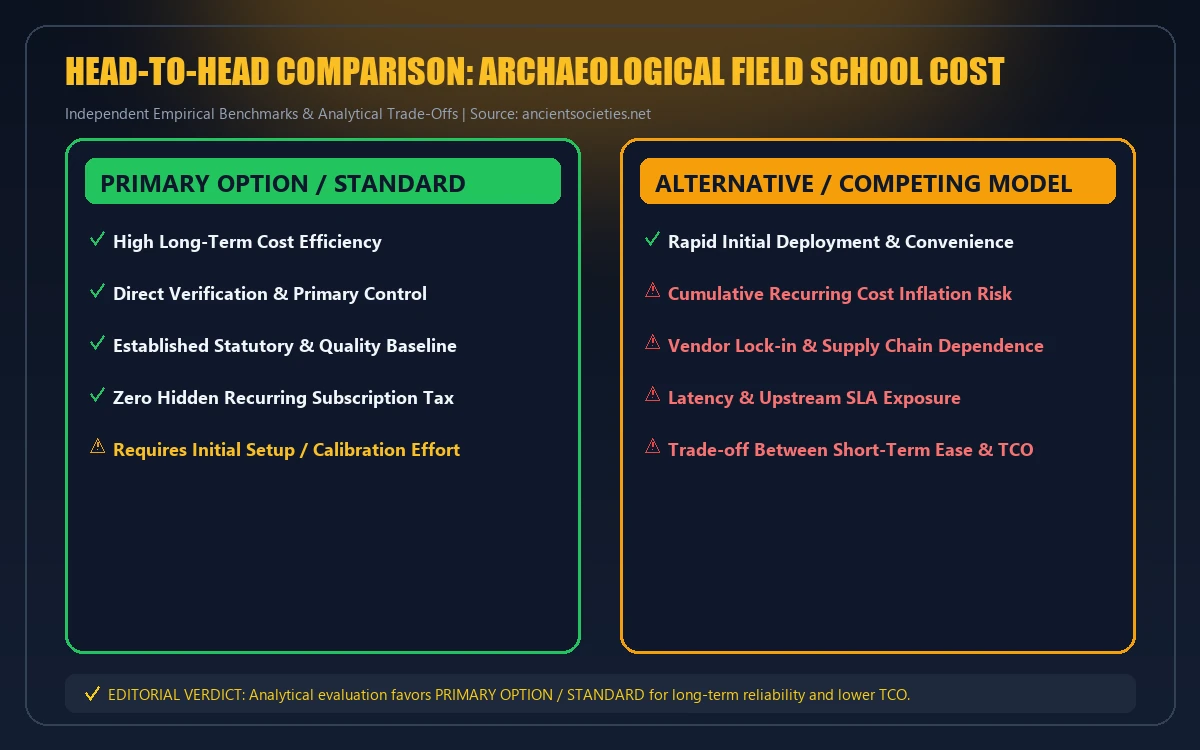
Four structural drivers set program pricing: faculty-to-student ratio, site logistics, housing model, and accreditation overhead. Per RPA field school certification standards, a compliant program requires a maximum 1:6 instructor-to-student ratio, minimum 120 total contact hours, at least 80 hours of field excavation or survey, and 20 hours of artifact processing. Maintaining that ratio with credentialed staff is expensive. Programs that cut corners on ratio also cut corners on compliance training, which CRM employers notice immediately.
Domestic university-affiliated programs at state schools typically run $1,800 to $2,500 for tuition, with room and board adding $600 to $1,200 for a four-to-six-week session. Private programs at independent research institutes charge $3,500 to $5,500. Overseas excavation programs in the Mediterranean, Near East, and Mesoamerica range from $5,500 to $12,000 all-in once flights, visas, and in-country transport are counted. The cost difference is real. So is the ROI difference.
Field school tuition also varies by credit structure. A program offering three transferable graduate credit hours prices those credits at the host institution’s per-credit rate, which at many state universities runs $400 to $900 per credit. Non-credit programs eliminate that overhead but may complicate transcript documentation for federal qualification purposes. Programs offering both credit and non-credit tracks give students the cleaner credential path without forcing full tuition at a private institution.
Archaeological Field School Cost vs. CRM ROI: The Domestic Advantage
Here is the arithmetic most program brochures will not show you. An $8,000 Mediterranean villa excavation teaches balk-face reading, wheelbarrow logistics, and stratigraphic drawing in contexts that bear no relationship to North American CRM practice. U.S. Cultural Resource Management firms conducting Phase I Shovel Test Pit surveys under Section 106 of the National Historic Preservation Act need technicians who can drive a 50-centimeter shovel probe at 30-meter intervals across a transect, classify soil horizons using the Munsell Soil Color Chart, log GPS coordinates via Trimble units, and document findings in Section 106 compliance formats. None of those skills transfer from a Mediterranean trench.
A domestic state university program at $1,800 to $2,500 that covers STP methodology, Munsell soil classification, Trimble GPS mapping, and Section 106 compliance training positions a graduate for immediate hire as a CRM Technician I. Per federal Service Contract Act archaeological wage determinations, the SCA sets Archeological Technician I (Code 30021) federal floor wages that vary by contract locality and are reissued periodically. In high-demand metro areas like the Washington D.C. region (Wage Determination No. 2015-4281, Code 30021) and coastal California, SCA determinations for Code 30021 positions have run $24 to $31.85 hourly. In lower-cost interior states, the same code floors at $20.14 to $23 hourly. A tech working 40 hours per week at $22/hr earns $45,760 annually; at $26/hr on federal contracts in high-wage localities, that climbs to $54,080.
| Program Type | Tuition Range | CRM-Ready Skills | Time to First Hire | Est. Annual Wage |
|---|---|---|---|---|
| Domestic state university | $1,800–$2,500 | STP, Munsell, Trimble GPS, Sec. 106 | 0–3 months post-program | $45,760–$54,080 |
| Private domestic institute | $3,500–$5,500 | Variable; depends on curriculum | 1–6 months | $45,760–$54,080 |
| Overseas Mediterranean/Near East | $5,500–$12,000 | Stratigraphic excavation, classical methods | 6–18 months (retraining needed) | $40,000–$45,000 |
| NSF REU (funded) | $0 + stipend | Research-focused; varies by site | Variable | Stipend ~$600/wk during program |
The wage payback period on a $2,200 domestic program at $22/hr CRM wages is under three weeks of full-time work. The payback period on a $10,000 overseas program, accounting for the retraining lag before CRM hire, can stretch past 18 months.
Named Programs and 2025 Tuition Figures
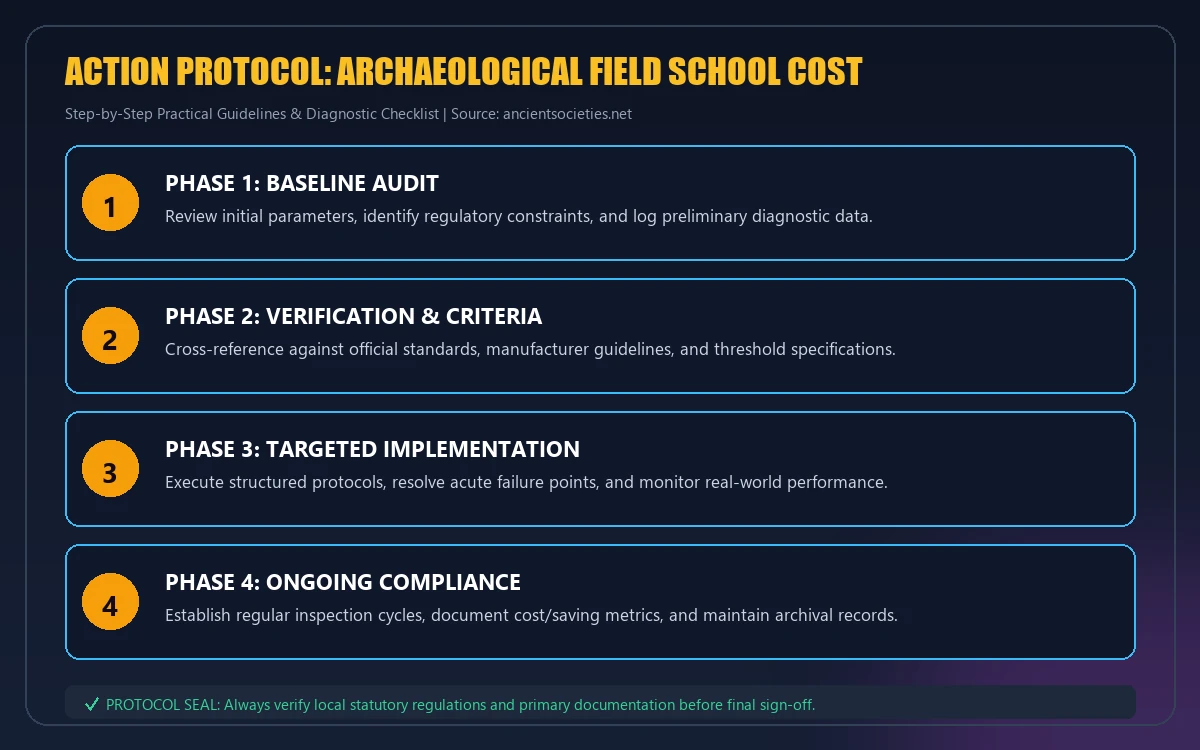
Abstract pricing categories are useful framing. Actual program names are more useful. Here are programs with published figures that illustrate the cost spectrum:
Crow Canyon Archaeological Center (Cortez, CO): $3,200 for a two-week adult program, $2,400 for the undergraduate session. Not university-credit-bearing in all configurations, but widely respected by Four Corners CRM employers. Pueblo archaeology context; strong artifact processing component.
Passport in Time (U.S. Forest Service, nationwide): $0 tuition. Volunteer archaeology and historic preservation projects on federal lands. No academic credit, no RPA-certifiable contact hours, but zero archaeological field school cost and genuine field exposure for students testing the discipline before committing tuition.
University of Leicester School of Archaeology and Ancient History (Leicester, UK): published overseas fees for excavation field schools typically run £2,500 to £4,000 for a four-to-six-week session, plus airfare. Strong stratigraphic training, no North American compliance component.
University of Sheffield Department of Archaeology (Sheffield, UK): published field school fees in the £2,000 to £3,500 range for summer excavation sessions. Same calculus as Leicester: excellent for academic track, poor CRM ROI for U.S. graduates.
NSF REU Sites in Archaeology (multiple host institutions): $0 tuition, travel covered, housing covered, stipend approximately $600/week for eight to ten weeks. Competitive application, research proposal required. For eligible undergraduates, this is categorically the best archaeological field school cost outcome available anywhere.
These programs span the full cost range. The pattern is consistent: domestic compliance-focused programs cluster at $1,800 to $3,200 and produce CRM-ready graduates; overseas classical programs cluster at $5,500 to $12,000 and produce graduates who need retraining before CRM hire.
When Overseas Programs Are the Right Choice
The CRM ROI argument for domestic programs is correct and important. It is also incomplete if stated without qualification, and a specialist who omits the qualification is doing students a disservice.
Overseas field schools are the superior choice for three specific career tracks. Students targeting tenure-track academic positions in classical, Near Eastern, or Mediterranean archaeology need site-specific excavation experience that domestic programs cannot replicate, since hiring committees at research universities read a Sardis or Çatalhöyük season as a genuine credential signal rather than a tourist detour. Museum curators and collection managers specializing in Old World material culture similarly benefit from hands-on excavation context in the relevant geographic tradition. International heritage management careers, particularly those involving UNESCO World Heritage site administration or bilateral cultural property agreements, require demonstrated field experience in the relevant regional tradition.
For those three tracks, paying $7,000 to $10,000 for a Mediterranean or Near Eastern field school is not a financial mistake. It is a correct investment in the specific credential the target employer values. The mistake is paying that price while targeting a CRM career in the American Southeast or Great Plains, where the credential produces no hiring advantage and the skill gap produces a measurable wage delay.
Students should identify their target employer before selecting a program, not after. That sequencing is obvious in retrospect and apparently non-obvious in practice, given how many CRM hiring managers report interviewing candidates who spent $8,000 on overseas programs and cannot describe STP interval methodology.
Federal Qualification Standards: What 36 CFR Part 61 Actually Requires
Secretary of the Interior 36 CFR Part 61 qualification standards set the minimum qualification standards federal agencies must apply when hiring archaeology and historic preservation personnel. The archaeology principal investigator standard requires a graduate degree plus four months of supervised field experience, satisfied by an accredited field school. RPA is the professional certifying body; 36 CFR Part 61 is the federal hiring floor. The regulation does not specify geography. It does not reward prestige. It requires documented supervised hours that satisfy the 36 CFR Part 61 threshold, and nothing else.
A student paying $10,000 for an overseas dig that lacks RPA certification produces a transcript entry, not a qualifying credential. RPA field school certification standards require the program itself to meet the 120-hour contact minimum, the 80-hour excavation floor, and the 1:6 ratio cap. Programs advertising "field experience" without meeting those benchmarks do not satisfy the federal qualification pathway regardless of archaeological reputation.
Graduate students pursuing the PI track should verify three things before enrolling: whether the program holds RPA field school certification, whether the host institution’s credits transfer to their degree program, and whether the fieldwork context includes compliance-relevant methodology. A Neolithic tell in Turkey is archaeologically significant. It does not teach Section 106 consultation procedure or Phase I STP survey protocol, which federal employers require.
Funded Pathways That Reduce Archaeological Field School Cost to Zero
$600 per week, travel covered, housing covered, tuition waived. That is the NSF REU offer, and most students applying to paid programs have not seriously investigated whether they qualify for it. NSF REU archaeology stipend programs represent the highest-value option available to undergraduates: Research Experiences for Undergraduates awards fully cover travel, room, and board while paying students approximately $600 per week in stipend, eliminating the $3,500 to $7,000 private program tuition barrier entirely. Acceptance is competitive and requires a research proposal component, but the financial outcome is categorically superior to any paid program. Students exit with field hours, a research deliverable, faculty relationships, and money in their account rather than debt. The $600/week figure is a common benchmark across recent REU cohorts, though individual site awards vary by NSF grant terms and year, so verify current stipend amounts directly with each REU site before applying.
State-level historic preservation offices (SHPOs) and tribal historic preservation offices (THPOs) periodically fund field training through Section 106 compliance projects. These positions pay SCA wages during training rather than charging tuition, which inverts the standard archaeological field school cost model entirely. Students working SHPO-funded compliance surveys earn $18 to $24/hr while accumulating field hours that satisfy RPA certification requirements. Availability is geographically uneven but worth tracking through state archaeology office newsletters and the SHA job board.
University assistantship structures offer a third funded pathway. Graduate teaching or research assistants at institutions running their own field schools often receive tuition waivers plus stipends covering the field session. Net archaeological field school cost for a funded graduate assistant at a state university can drop to $0 before the stipend is counted.
RPA Certification and Long-Term Wage Trajectory
Per RPA field school certification standards, students must accumulate the 120-hour contact minimum through an RPA-certified program before their hours count toward professional membership eligibility. Field school completion is a prerequisite, not a substitute, for full RPA membership, which additionally requires a graduate degree and supervised post-degree field experience.
BLS archaeological employment and wage data peg 2023 median pay for archaeologists at $63,800 annually ($30.67/hour), with projected 4% ten-year growth. BLS OOH figures reflect May 2023 wage data, published April 2024; the next OOH update (spring 2025) will carry May 2024 data. That median reflects the full credential stack: degree, field school, field experience, and typically RPA membership or equivalent professional standing. Entry-level CRM technicians without graduate degrees earn closer to the SCA locality floor. The wage gap between technician floor and professional median is bridged almost entirely by graduate credentials and accumulated field documentation, which is why the sequencing of field school, degree, and post-degree field hours matters as much as the dollar figure on the program invoice.
Viewed against that trajectory, archaeological field school cost is a recoverable investment when the program produces CRM-relevant skills and a compliant credential. At $22/hr on federal CRM contracts, a technician who spent $2,200 on a domestic program recovers that cost in roughly 100 work hours. The technician who spent $10,000 on an overseas program and required six months of on-the-job retraining before reaching hire-ready STP speed faces a fundamentally different payback curve, one that extends well past the first year of employment.
Section 106 Compliance Training: The Skill Gap That Costs Jobs
CRM firms exist primarily to execute Section 106 consultation and survey on behalf of federal agencies and federally permitted projects. Phase I STP survey is the standard methodology: shovel probes at systematic intervals, Munsell soil horizon documentation, artifact recovery and processing, and report preparation in formats acceptable to the relevant SHPO. Field schools that do not teach this methodology produce graduates who know how to excavate but not how to comply.
Programs worth scrutinizing before enrollment include any that advertise "archaeological methods" without specifying Phase I STP survey, any that operate exclusively on prehistoric or classical sites outside North America, and any that do not include artifact processing in their contact hour structure. The 20-hour artifact processing requirement in RPA standards exists precisely because lab work is where Munsell matrix reading, provenience logging, and compliance documentation consolidate into transferable skills.
Frequently Asked Questions
What is a realistic total archaeological field school cost budget for 2025, including living expenses?
Domestic state university programs run $2,800 to $4,500 all-in: tuition, on-site housing, meals, field supply kit. Overseas programs require $8,000 to $14,000 once flights, visas, and in-country transport are added. NSF REU programs eliminate tuition and pay a weekly stipend, making them the strongest financial outcome for eligible undergraduates. Verify current REU stipend amounts directly with each site, as figures vary by grant year.
Can volunteer excavation hours substitute for certified field school credits on a CRM application?
No. Volunteer participation fees of $150 to $400 per week produce no RPA-certifiable contact hours and satisfy no 36 CFR Part 61 supervised experience requirements. Volunteer experience adds value on top of a certified credential but cannot replace it. Complete the certified program first; volunteer afterward to build additional site-hours.
Which field school skills do CRM hiring managers actually screen for in phone interviews?
Phase I STP survey speed, Munsell Soil Color Chart proficiency, Trimble GPS unit operation, and Section 106 compliance report familiarity are the four skills project managers consistently name. Candidates who can articulate STP interval methodology and describe soil horizon classification in concrete terms routinely receive offers within 30 to 90 days of program completion. Candidates who cannot, regardless of overseas excavation experience, typically require retraining before deployment on live compliance projects.
Do field school hours count toward RPA membership before completing a graduate degree?
Hours accumulate and should be documented carefully, but they do not activate RPA membership eligibility without the graduate degree. Full RPA membership requires a graduate degree in archaeology or a closely related field plus supervised post-degree field experience. Complete the field school early, preserve all contact hour documentation, then build the degree credential rather than attempting both simultaneously and producing incomplete records for either.
References
-
U.S. National Park Service / 36 CFR Part 61 (Secretary of the Interior’s Standards)
URL: https://www.nps.gov/history/local-law/arch_stnds_9.htm
Year: 2024
Benchmark: Sets minimum qualification standards federal agencies must apply when hiring archaeology and historic preservation personnel. Archaeology PI-level standard requires graduate degree plus four months supervised field experience, satisfied by accredited field school. -
U.S. Bureau of Labor Statistics / Occupational Outlook Handbook
URL: https://www.bls.gov/ooh/life-physical-and-social-science/anthropologists-and-archaeologists.htm
Year: 2024
Benchmark: 2023 median pay $63,800 annually ($30.67/hour); projected 4% ten-year growth; accredited field school completion required for baseline entry-level field technician positions. Figures reflect May 2023 wage data, published April 2024. -
Register of Professional Archaeologists / RPA Field School Certification
URL: https://rpanet.org/field-school-certification
Year: 2024
Benchmark: Certification requires minimum 120 total contact hours, minimum 80 hours field excavation/survey, 20 hours artifact processing, maximum 1:6 instructor-student ratio. -
U.S. Department of Labor / SAM.gov Service Contract Act Wage Determinations
URL: https://sam.gov/content/wage-determinations
Year: 2025
Benchmark: Service Contract Act establishes Archeological Technician I (Code 30021) federal floor wages varying by contract locality; ranges from $20.14/hr in lower-cost interior states to $31.85/hr in high-wage metro areas. Determinations are reissued periodically and are locality-specific. -
National Science Foundation / REU Sites in Archaeology
URL: https://www.nsf.gov/crssprgm/reu/reu_search.jsp
Year: 2024
Benchmark: Archaeology REU awards eliminate student costs through fully paid travel, room, board, plus approximately $600 weekly student stipends (amounts vary by site and grant year), bypassing $3,500 to $7,000 private tuition gatekeeping.