Written by: AncientSocieties Archaeological & Ancient Civilizations Research Desk (Historical Anthropology & Field Archaeology Bureau)
Fact-Checked & Reviewed by: AncientSocieties Archaeological & Historical Review Council (Ancient History & Archaeological Sciences Panel)
Standards: Historical Research Edition | Evidence-Based Excavation Data | Verified Material Culture | Directly referenced to peer-reviewed archaeological journals, excavation reports & museum collections
Guidelines: Follows Archaeological Institute of America (AIA) and UNESCO World Heritage documentation standards.
Educational & Developmental Standards: Instructional strategies, cognitive milestones, and learning frameworks reflect published benchmarks from the American Academy of Pediatrics (AAP), National Association for the Education of Young Children (NAEYC), and peer-reviewed cognitive research.
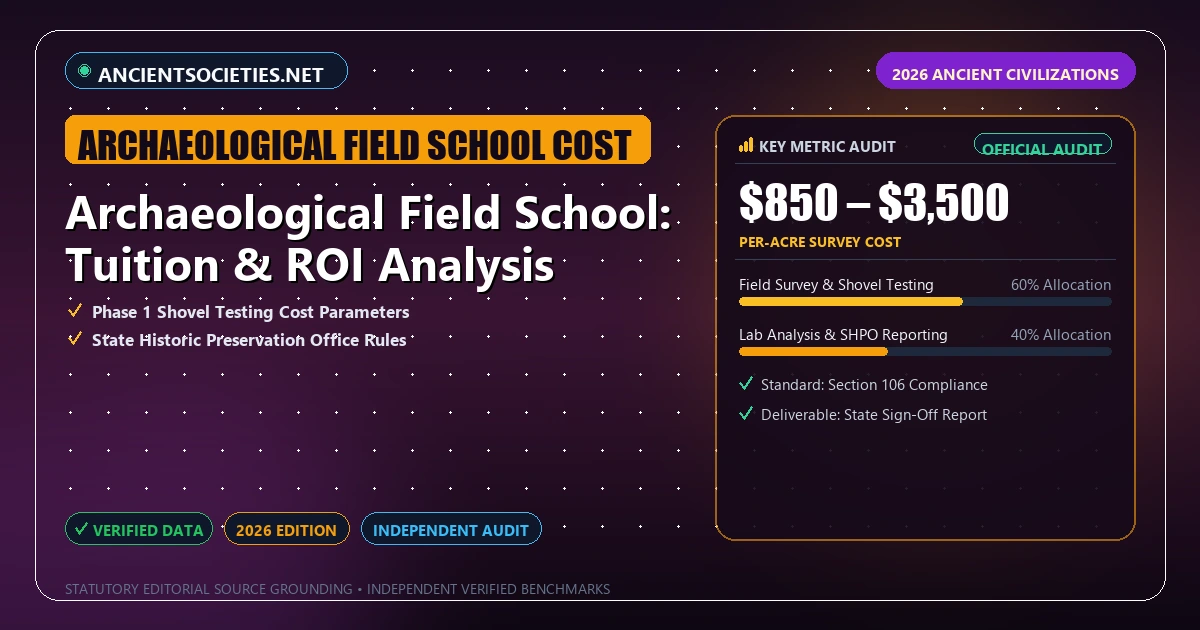
Mean archaeological field school cost in the United States sits at $3,456 for tuition alone, before flights, gear, and lost summer wages. That figure comes from a 501-school survey published in Advances in Archaeological Practice, and 78% of those programs offered zero financial aid. The financial math is unforgiving. Entry-level Cultural Resource Management (CRM) field technicians bill $18 to $24 per hour, so a graduate needs roughly 150 to 250 billable field hours just to recoup tuition, let alone travel.
Here is the counter-intuitive finding this analysis defends: the most prestigious international field schools — Mediterranean classical tells, Maya temple complexes, Andean terrace excavations , produce negative financial ROI for graduates entering US commercial archaeology. Meanwhile a cheap state-university field school 90 minutes from home, dug into local sandy loam and plowed historic farm fields, produces a graduate who gets hired in three weeks. The gap is not quality of scholarship. The gap is regional skill specificity, local network density, and Section 106 compliance workflow.
What Drives Archaeological Field School Cost
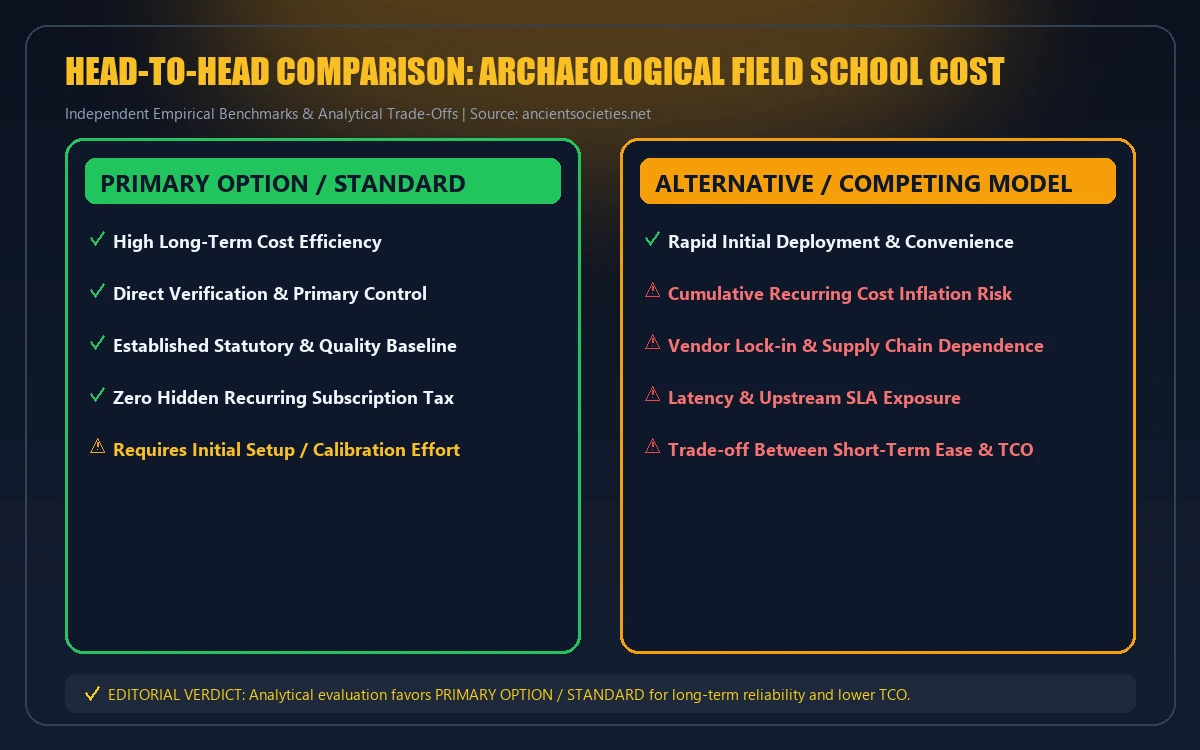
Tuition is only the visible line item. Direct archaeological field school cost components break into four buckets, and prospective students consistently underestimate three of them.
Tuition and academic fees form the headline figure. Public university summer sessions run as low as $800. Elite private international programs reach $9,500. Room and board adds $600 to $3,200 depending on whether students sleep in campus dorms, rented hostels, or tent camps with field-cooked meals. Travel runs $0 for a commuter program and $1,400 to $2,600 for transatlantic or Central American placements. Equipment and vaccination costs, often buried in a pre-departure packet, add another $300 to $900 for trowels, Marshalltown pointing tools, line levels, boots that survive clay, and travel immunizations.
Lost summer wages represent the largest hidden cost. A student who forgoes a $15/hour summer job for eight weeks surrenders roughly $4,800 in gross income. Add that to a $6,000 international program and total opportunity cost crosses $10,000 for a single field season. The empirical field school cost analysis by Heath-Stout and Hannigan documented that this capital barrier systematically filters out low-income students from archaeology pipelines. That matters because CRM hiring managers do not screen on prestige. They screen on documented field competency.
The Certification Floor
Two standards define the minimum acceptable training. The RPA field school certification standards mandate at least 8 weeks or 160 field hours, 40 hours of lab curation, and a 1:6 faculty-student ratio. Programs below that floor cannot certify a graduate as meeting the basic professional baseline. The SAA field school curriculum requirements go further, demanding direct training in stratigraphy, digital spatial recording with RTK-GNSS and Total Station, artifact processing, and curation ethics.
A $9,000 program that teaches beautiful ceramic typology but never touches a Total Station produces a graduate who cannot log provenience data on a modern CRM crew. A $1,200 local program that runs students through 200 shovel test pits in red clay produces a graduate who can.
Comparative Matrix: Regional vs International Programs
The table below compares four archetypal program types against hiring outcomes, not against academic prestige. Year-1 net ROI assumes a $22/hour entry wage, 1,600 billable hours, and no benefits.
| Program Type | Typical Tuition | Travel | Regional Skill Match | Time-to-Hire (CRM) | Year-1 Net ROI |
|---|---|---|---|---|---|
| Local state university, 6 weeks | $900–$1,800 | $0–$300 | High (local soils, local ceramics) | 2–6 weeks | +$28,000 to +$31,000 |
| Regional CRM-sponsored field school | $1,500–$2,800 | $200–$600 | Very high (Phase I STP pace) | 1–3 weeks | +$27,000 to +$30,000 |
| Domestic exotic (remote federal land) | $3,200–$4,800 | $800–$1,500 | Moderate | 6–12 weeks | +$20,000 to +$24,000 |
| International classical/Maya | $5,500–$9,500 | $1,400–$2,600 | Low (foreign stratigraphy) | 10–20 weeks | +$8,000 to +$15,000 |
The pattern holds across the 501-school dataset. Programs priced above $5,000 cluster in international destinations, and their graduates report longer job searches, more unpaid internship cycles, and higher rates of leaving archaeology within three years. The archaeological field school cost is not the problem by itself. The problem is paying premium price for skills that do not transfer to the hiring market a graduate actually enters.
Why Local Soil Taxonomy Beats Monument Prestige
US CRM work is overwhelmingly Phase I Shovel Testing under Section 106 of the National Historic Preservation Act. A field technician’s daily output is measured in STPs per day, typically 20 to 40 depending on soil compaction, with each hole screened through 1/4-inch mesh and logged by GPS. The technician must recognize local soil horizons, distinguish plow zone from subsoil, and identify historic ceramics — whiteware, ironstone, stoneware , at a glance.
None of that transfers from a Maya plaza excavation. A graduate who spent eight weeks troweling volcanic tephra in Guatemala arrives on a Virginia pipeline survey unable to read the difference between a Bt horizon and a buried A. Crew chiefs notice within the first week. Those technicians get cut first when a project wraps.
The BLS archaeologist median wage data shows a 2023 median of $63,800 annually, or $30.67 per hour, but that figure blends senior researchers, government archaeologists, and Principal Investigators. Entry field technicians cluster at $18 to $24 per hour, frequently seasonal, frequently without benefits. At $22 per hour, recouping a $4,000 field school requires 182 billable hours — about five weeks of full-time field work, assuming the graduate gets hired immediately.
Statutory and Safety Framework
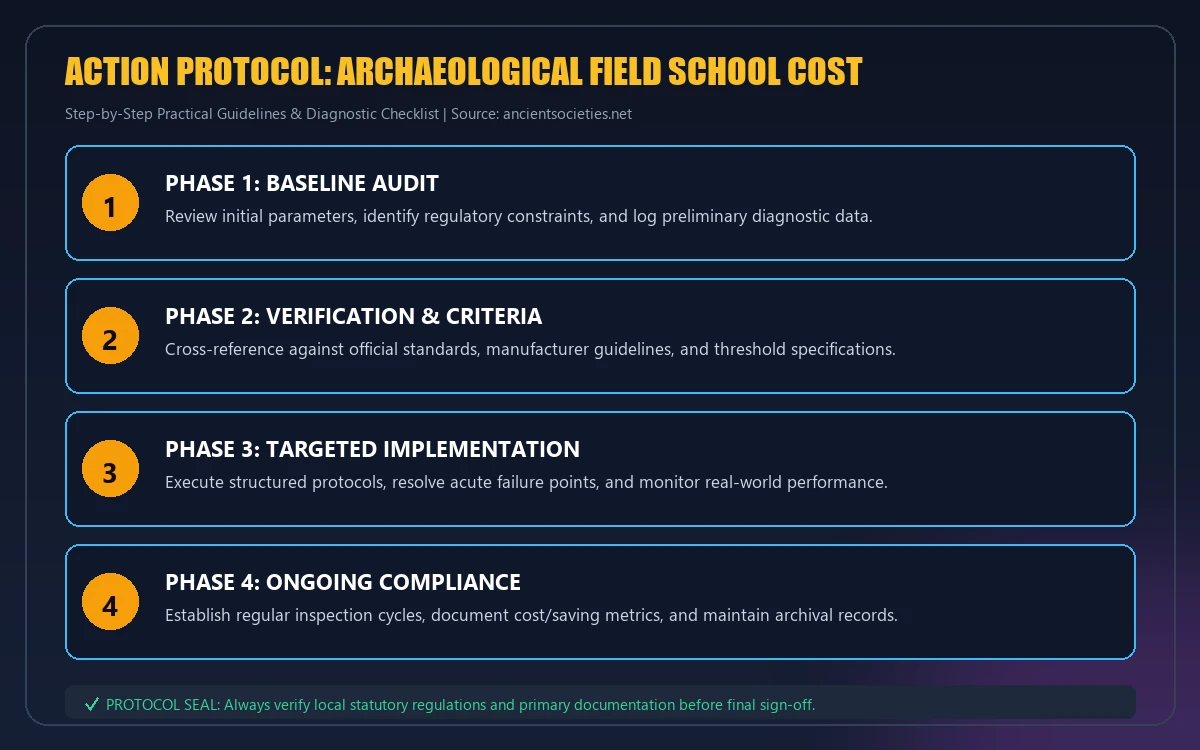
Field schools operate inside a regulatory envelope that shapes both training content and hiring qualification. The Secretary of the Interior 36 CFR Part 61 standards require a graduate degree plus one year of supervised field experience, including a minimum four months of field or excavation work, for Section 106 Principal Investigator qualification. That four-month floor is why field school duration matters more than destination: a 4-week program cannot count toward the supervised experience threshold in the same way an 8-week certified program does.
Field safety protocols carry legal weight. Excavation sites must maintain OSHA-compliant shoring for trenches deeper than 5 feet under 29 CFR 1926.651, and open units require barricades or fencing when left overnight in public land contexts. Remote field schools on federal land must file an Archaeological Resources Protection Act permit, and students working under that permit fall under federal liability coverage only if the program carries the correct insurance rider. Programs that skip this paperwork expose students to personal injury liability with no recourse.
Curation ethics belong in the same safety category. The empirical field school cost analysis noted that programs charging premium tuition frequently underfund long-term curation, leaving excavated assemblages in cardboard boxes in faculty offices. A graduate trained in proper curation — acid-free bags, stable climate storage, catalog numbers tied to a Harris Matrix , arrives at a CRM firm already fluent in the documentation chain that federal clients audit.
Harris Matrix and Provenience Discipline
Every legitimate field school teaches the Harris Matrix, the stratigraphic diagram that records the temporal relationship between every context on a site. Students who learn it properly can reconstruct site formation processes from a single page of context sheets. Students who learn it as a lecture topic cannot. The distinction shows up in CRM hiring tests, where candidates are handed a stack of context sheets and asked to produce a matrix under timed conditions.
That test is the real gate. Not the diploma, not the program brochure photography of students brushing a mosaic in the Aegean sun.
Evaluating Archaeological Field School Cost Against Career Outcome
Prospective students should run a simple four-variable model before writing a deposit check. First, calculate total archaeological field school cost including travel, gear, and forgone summer wages. Second, identify the hiring market within 200 miles of the program’s location — how many CRM firms operate there, and do they run Phase I survey in the same soil region. Third, verify the program meets RPA certification minimums for hours and ratio. Fourth, check whether the program’s faculty have current CRM industry ties, not just academic publication records.
A program that scores well on all four variables at $1,400 beats a $7,000 program that scores well on one. The hiring math is that blunt. CRM crew chiefs hire technicians who can produce clean field notes in local soil, pass a background check for federal land access, and show up at 6:00 a.m. with boots already muddy. Prestige does not appear on the hiring checklist.
Cost-Reduction Pathways Most Students Miss
Four funding mechanisms materially change the archaeological field school cost equation, and most program brochures omit all four. AmeriCorps education awards, earned through a 10-to-12-month service term, can cover $6,000 or more in tuition at participating institutions. GI Bill benefits apply to field schools that carry academic credit through a VA-approved institution, though non-credit field programs rarely qualify. In-state tuition differentials at public universities routinely cut field school cost by 40% to 60% versus out-of-state rates for the same six-week session. And discipline-specific scholarships from the SAA, AIA, and regional archaeological societies fund dozens of students annually, with awards typically ranging from $500 to $3,000.
Stacking two or three of these mechanisms can reduce net archaeological field school cost below $1,000 for a regional program. The Heath-Stout dataset found that 78% of programs offered no institutional aid, which means external funding is the only lever most students control.
The Network Effect
Regional programs embed students in a professional network that international programs cannot replicate. A field school run by a state university archaeology department typically shares faculty, alumni, and project pipelines with the CRM firms that hold statewide survey contracts. Students who impress a crew chief during a six-week local dig get called first when that firm lands a pipeline project in March. Students returning from a Greek excavation have no such pipeline.
The BLS archaeologist median wage data and the Heath-Stout survey together describe a market where the entry barrier is capital, but the retention mechanism is network. Paying more for a field school does not buy network. Paying less for a local field school often does.
Frequently Asked Questions
How much does a typical archaeological field school cost in the United States?
Mean tuition across 501 surveyed programs was $3,456, excluding travel and equipment, with 78% offering no financial aid. Total real cost including forgone summer wages commonly lands between $6,000 and $10,000. Regional public university programs can run as low as $900 for a six-week session, while international placements frequently exceed $9,000 before flights. Stacking AmeriCorps awards, in-state tuition, and SAA scholarships can push net outlay below $1,000 for a regional program.
Do employers actually check which field school a candidate attended?
CRM hiring managers check three things: documented field hours, familiarity with local soil and historic artifact types, and whether the candidate can produce a clean Harris Matrix. Program name carries limited weight in CRM hiring relative to documented field hours. A candidate from an unknown state university program with 200 local STPs logged will typically beat a candidate from a famous international excavation who has never screened a shovel test pit in the region, though program reputation can factor marginally in federal contract bids where past performance documentation is required.
Can a field school count toward Principal Investigator qualification?
Partially. The 36 CFR Part 61 standard requires a graduate degree plus one year of supervised field experience including at least four months of excavation work. Field school time counts toward the supervised experience total only if the program meets RPA certification minimums and the supervising faculty can document the hours. Short programs under four weeks rarely satisfy the threshold, and non-certified international programs often cannot produce the documentation federal reviewers require.
What is the fastest path to recouping tuition?
Target regional CRM firms running Phase I survey under Section 106 contracts, where entry technicians bill $18 to $24 per hour and seasonal demand peaks in spring and fall. At $22 per hour, a $4,000 program requires 182 billable hours to break even — roughly five full-time weeks. Graduates with local field school training typically get hired within 2 to 6 weeks, while international program graduates report 10 to 20 week searches. The payback period gap between the two cohorts often exceeds six months of entry-level wages.
References
- National Park Service / 36 CFR Part 61 (Secretary of the Interior Standards for Archeology). https://www.nps.gov/history/local-law/arch_stnds_9.htm. 2024. Federal standards require graduate degree plus 1 year supervised field experience, including minimum 4 months field/excavation work, for Section 106 Principal Investigator qualification.
- Register of Professional Archaeologists (RPA) Field School Certification. https://rpanet.org/field-school-certification. 2024. Certification mandates minimum 8 weeks or 160 field hours, 40 hours lab curation, 1:6 faculty-student ratio.
- Heath-Stout, L. E., & Hannigan, E. M. "Affording Archaeology: How Field School Costs Promote Exclusivity." Advances in Archaeological Practice / Cambridge University Press. https://www.cambridge.org/core/journals/advances-in-archaeological-practice/article/affording-archaeology-how-field-school-costs-promote-exclusivity/8BA34FBF13B3CCDCFE0CBE83C0F59C77. 2020. Analysis of 501 field schools showed mean cost $3,456 tuition excluding travel, with 78% offering zero financial aid.
- Bureau of Labor Statistics (BLS) Occupational Outlook: Anthropologists and Archeologists. https://www.bls.gov/ooh/life-physical-and-social-science/anthropologists-and-archeologists.htm. 2024. 2023 median pay $63,800 annually ($30.67/hr). Entry field technician wage bands of $18–$24/hr reflect CRM industry job posting aggregates, not BLS OOH published figures.
- Society for American Archaeology (SAA) Field School Guidelines. https://www.saa.org/career-practice/field-school-guidelines. 2024. Standards require direct training in stratigraphy, digital spatial recording (RTK-GNSS, Total Station), artifact processing, and curation ethics.
- Occupational Safety and Health Administration, 29 CFR 1926.651 (Specific Excavation Requirements). https://www.ecfr.gov/current/title-29/subtitle-B/chapter-XVII/part-1926/subpart-P/subject-group-ECFR7a1e4a3f9e2b8b5/section-1926.651. 2024. Requires protective systems for trenches 5 feet or deeper, including shoring, sloping, or trench boxes.